Stanislav Koreň
Stanislav Koreň, sculptor and designer, turns ninety this year. His main contribution to cultural heritage is his design work, which is known to the public thanks to countless exhibitions of applied art until 1989, as well as presentations in the following years. Free-standing sculptural works can be found in architecture until 1989. Like most interior monumental works, they remained in the background.

The author is still dedicated to design and chamber work in his studio in Bratislava’s Koliba.
Stanislav Koreň was born in Svätý Anton in 1935. He began his studies at the State Industrial School in Banská Štiavnica under Professor Anton Drexler. In 1951, the carving department moved to Bratislava, where it became part of the Secondary School of Applied Arts. It continued to be led by Karol Drexler. Stanislav Koreň graduated in 1954 and became an artist at the ÚĽUV, where he worked for thirty years (1954 – 1984), in a leadership position since 1969. He was a long-time member of the Commission for Applied Arts at the SFVU.
Stanislav Koreň’s work is unmistakable due to his approach to matter and the principles of its shaping. His choice was the material of wood and the targeted use of its properties. He followed the tradition of folk art, where respect for the material and the very essence of wood — its colour and structure — had an aesthetic function. Stanislav Koreň also uses staining, but still preserves the natural beauty of the material. The basis of shaping, whether a utility object or a sculpture, is minimalism and the geometric composition of matter in space.
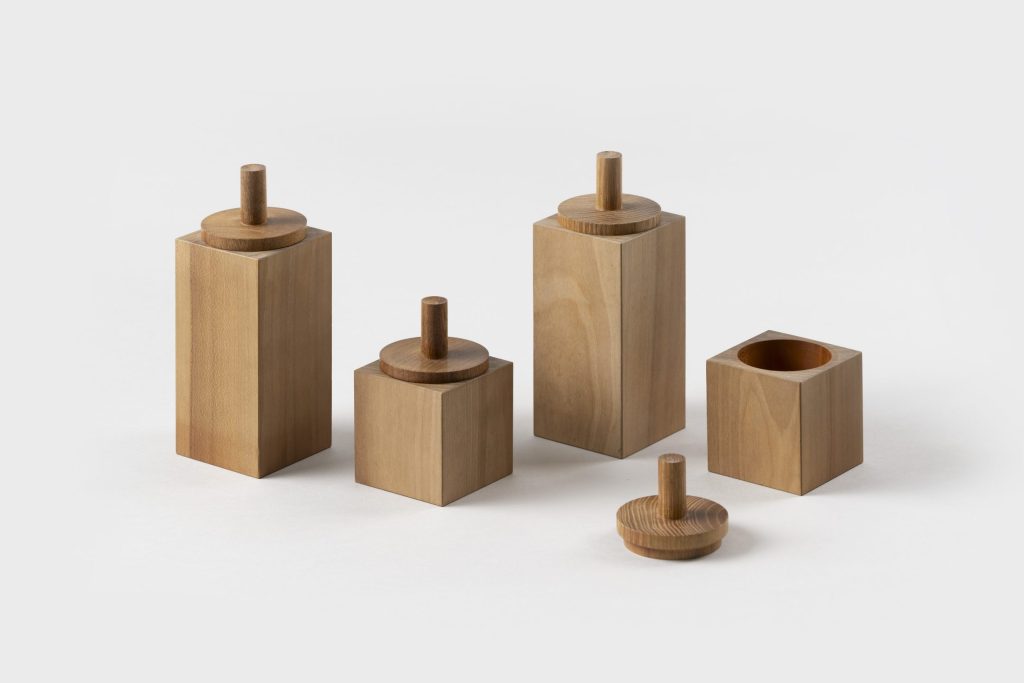
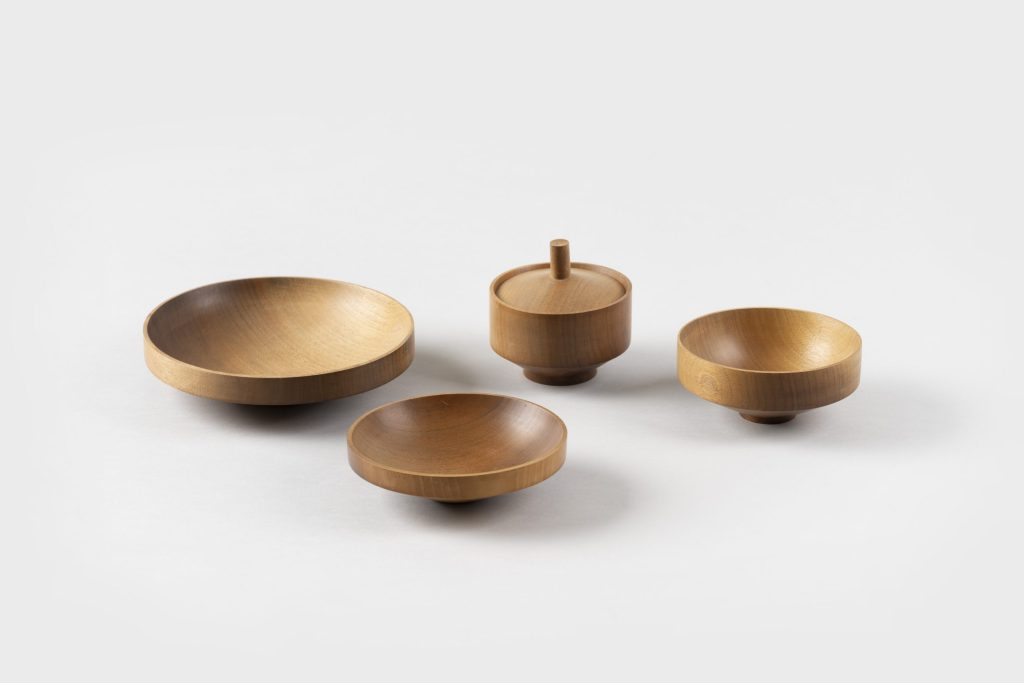
The focus of his work is designing small objects that we use in everyday life. He focused on dining sets, consisting of several components that communicate and complement each other in space, that is, on the table surface during everyday use. Their arrangement is a dialogue, connecting objects of different heights in a variable spatial composition.
Chopping boards, plates intended for dining, cutlery, bowls, vases and spice jars and other small objects stand out with their extremely simple shape and lines elegance. In his concept, they became objects on the table, which, with their mass and shape, complemented the interior not only as utilitarian objects but also as small sculptures or compositions of artefact objects. In his creations, he focused on wooden sculptures, most often composed as totemic figures. Initially, they are monochrome, mostly made of dark wood or darkly stained, but later he also began to use expressive polychromy. As with monumental reliefs or design, he also uses metal elements as accenting details in his chamber work. Clusters of metal spikes are common, disturbingly disturbing the smooth, visually pleasing surface and outline of the sculpture.
He has been engaged in monumental work since the mid-sixties. Along with the intensive construction of spa and hospital buildings, numerous opportunities emerged. Regarding the material, these are interior works, mainly reliefs, and more rarely full-bodied sculptures made of wood.