

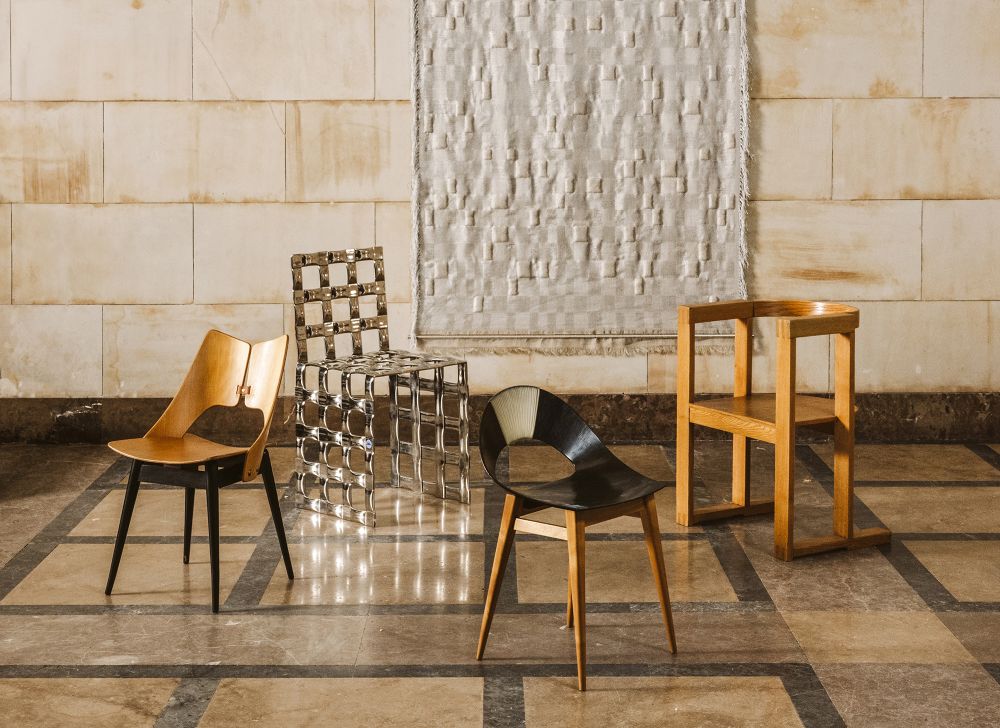
Design in the Fight for a Better World

Milánsky festival dizajnu je každý rok plný nepreberných inšpirácií, výstav a prezentácií. Každý rok sa ale z toho nekonečného množstva dizajnu vylúpne jeden projekt, ktorý ostatné zatieni. Tento rok sa ním stala výstava poľského modernizmu v Torre Velasca pomenovaná Polish Modernism. A Struggle for Beauty.
Every year, the Milan Design Festival offers endless inspiration, exhibitions, and presentations. However, every year, among the endless designs, one project stands out and overshadows the others. This year, it was the exhibition of Polish modernism in Torre Velasca called Polish Modernism. A Struggle for Beauty. Polish history differs in many ways from that of Czechoslovakia. Different historical experiences, along with the country’s population structure and character, created distinct frameworks for Poles’ lives. However, we can find clear parallels in many aspects, whether it is the interwar enthusiasm of architects and designers, or the unpleasant sobering up of creators in the 1950s. However, the directions and styles overlapped to some extent. Polish modernism also aimed primarily to offer the inhabitants, who gained independence in 1918 after 125 years, modern living options, as was becoming common in the West. New movements emerged, new cities were born, such as Gdynia in northern Poland, and designers sought to create products that would divert Poles from their rural lifestyle. “Modernism was dictated by economics, the reality of mass production, but also politics. In the new modernist society, anyone could become a user. Furniture and objects were no longer supposed to speak about the status of the person to whom they belonged,” recalls the exhibition curator Anna Maga in Vogue Polska, recalling the main principles on which (not only) interwar Polish modernism was based. Designers and artists such as Bohdan Lachert, Katarzyna Kobro, and Julia Keilowa were often in close contact with foreign tendencies, and the ideas of Le Corbusier or the Bauhaus naturally flowed into Poland. The tendency to democratize design and architecture played a major role across Europe at that time.
It is evident, for example, in the work of the aforementioned Julia Keilowa. The Polish sculptor and designer, who lived between 1902 and 1943, was one of the creators who could design everyday objects with a strong aesthetic impact. Her starting point was her study of sculpture at the Academy of Fine Arts in Warsaw, which is why her works create the impression of a small artistic solitaire. Her ball-shaped sugar bowl with wing-shaped supports, geometrically rectilinear ashtrays, and cubist-influenced drink sets were all very successful. In the spirit of the modern era, Keilowa also used modern materials, and most of her
products were made of stainless steel or plated brass. Thanks to cooperation with Polish factories such as Fraget or Bracia Henneberg, it was possible to mass- produce several products and thus get the perfect design into many Polish households. And that was exactly the goal the creators of that time had: cultivating the nation’s taste through small objects, as well as a modern, sometimes utopian approach to construction.
This category included the visionary architect Władysław Strzemiński, who in 1923 showed what a station in the newly built Gdynia could look like. His avant-garde design was strictly minimalist and austere, reflecting visions that radically desired to deviate from the current and widespread ornamentation. “A hundred years ago, modernism was a joint project developed not only by architects, but also by artists and theorists,” adds the exhibition curator Anna Maga for Vogue Polska magazine. And she highlights another key figure of this era, whose work also appeared in the exhibition – Katarzyna Kobro. The Polish artist worked together with her husband Władysław Strzemiński, and was known as an author who paid attention to a strict, almost mathematical form that shocked many people in her time. Although Kobro was primarily devoted to constructivism in the form of sculptures, she argued that these works should not be exhibited on a pedestal in galleries, but should serve as objects that define and shape public space. Like Julia Keilowa, she preferred inventive materials such as sheet metal, steel or glass for the time. Her approach to form can still be admired today in the Museum of Art in Łódź, where in 1946 she designed the interior of the Neoplastic Hall, which she also filled with her own sculptures. The original of her famous sculpture Spatial Composition from 1929 is also in the same city.