

Ivana Palečková: On The Dividing Line of Design And Photography
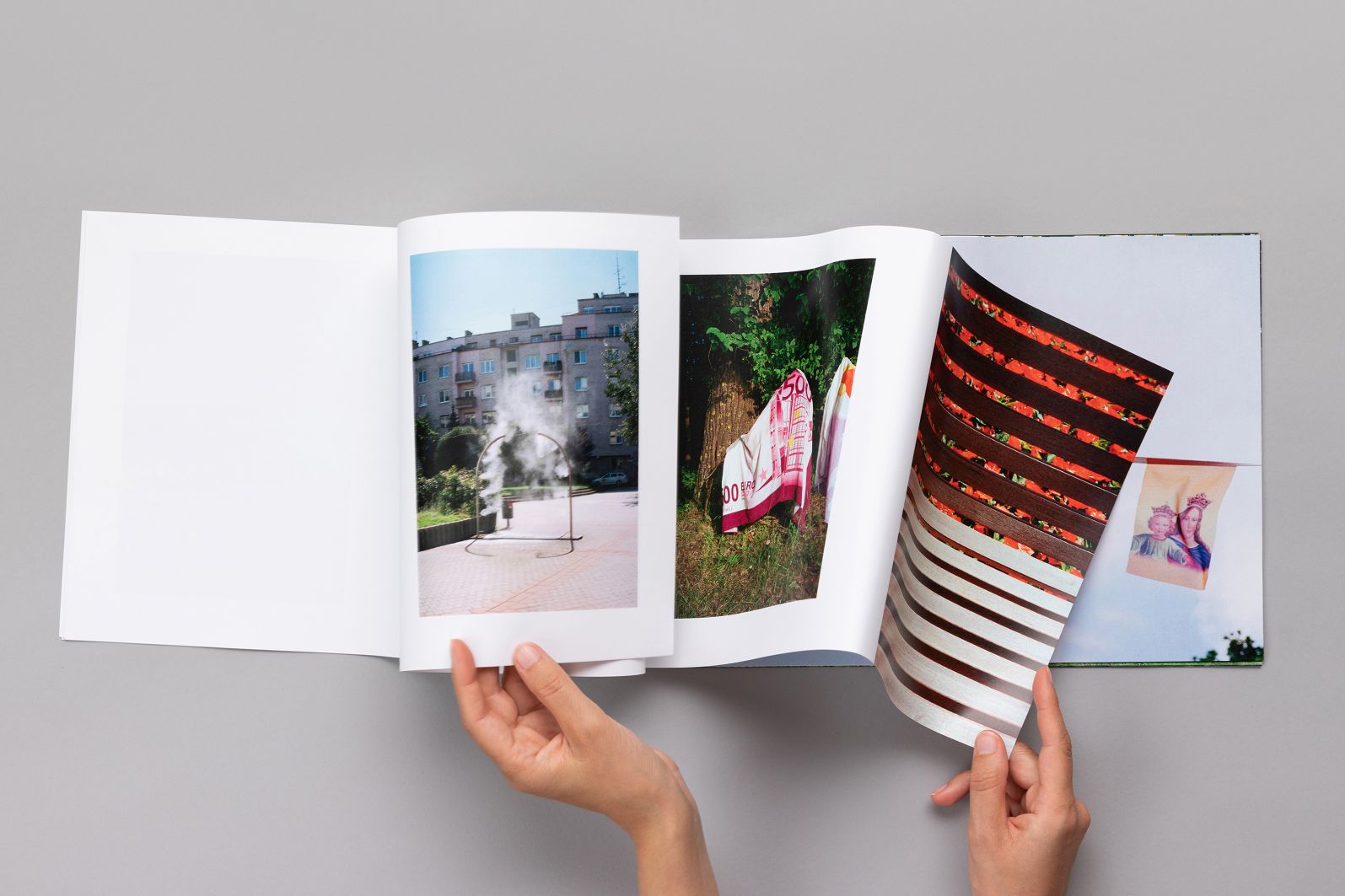
Ivana Palečková is a graphic designer who naturally oscillates between design and photography in her practice. Through photography, she has long been interested in public space and how people interact with it. She pursues creating single-author photography books, and in her latest, Vladimír Dedeček: Život architektúry (Čierne diery, 2025), she published more than 390 original photographs taken with an analogue camera. Her design portfolio is diverse: publications, numerous visual<br /> identities and packaging designs,<br /> illustrations, a type, a facade relief<br /> design, and even a rapper’s album<br /> cover. The 2020 winner of the Slovak<br /> Design Award says she often chooses<br /> projects that push her outside her<br /> comfort zone.
Your book Vladimír Dedeček: Život architektúry could be described as a Gesamtkunstwerk—it combines book design, architecture, and photography. Using almost four hundred photographs, you tell the stories of ten buildings. How did the idea to create such a book come about?
The idea for the book developed gradually. It started with one separate graphic of Dedeček’s building that I made for Čierne diery. Later, they offered me the opportunity to process another graphic, and then approached me about creating an entire series dedicated to Dedeček’s buildings. The original plan for the publication was more modest — we considered combining these risographs with analogue photographs. However, when I started photographing the buildings, many more and much more detailed photographs emerged than the original plan had anticipated. It naturally affected the book’s volume, and at some point, the combination of risographs and photographs stopped making sense.
The preparation of this publication required various processes that were demanding in terms of professionalism and capacity: travelling, photography, post-production, and final work on the publication design. What were you in charge of when making the publication?
My main part was photographing the selected objects. In addition, I handled production: I travelled on my own, developed film, and arranged access to buildings. However, this way of working was also familiar to me from other original projects. The work with photographic material itself took a lot of time: the selection, retouching, and preparation for printing. The key person in this process was Dominika Jackuliaková, a photographer and educator, with whom I had already collaborated on my previous books. She was my curatorial partner and, in a sense, a professional guarantor, since her main focus is original photography. I really appreciated having a second perspective on the creation process. I also consulted her on the layout design.
In one of your previous interviews, you said, “You take photos from the perspective of a designer, since you never studied photography.” How has your relationship with photography developed since then?
Photography is not a craft that I would like to offer commercially; I see it clearly as a separate artistic discipline. When it comes to visual identities, I naturally also work with photography, but mainly by developing concepts I pass on to other photographers. I don’t have the ambition to do it all myself. I’m more of a graphic designer, but it’s gradually becoming more even, or more intertwined and influencing me. In this sense, pigeon-holing has never really suited me.