

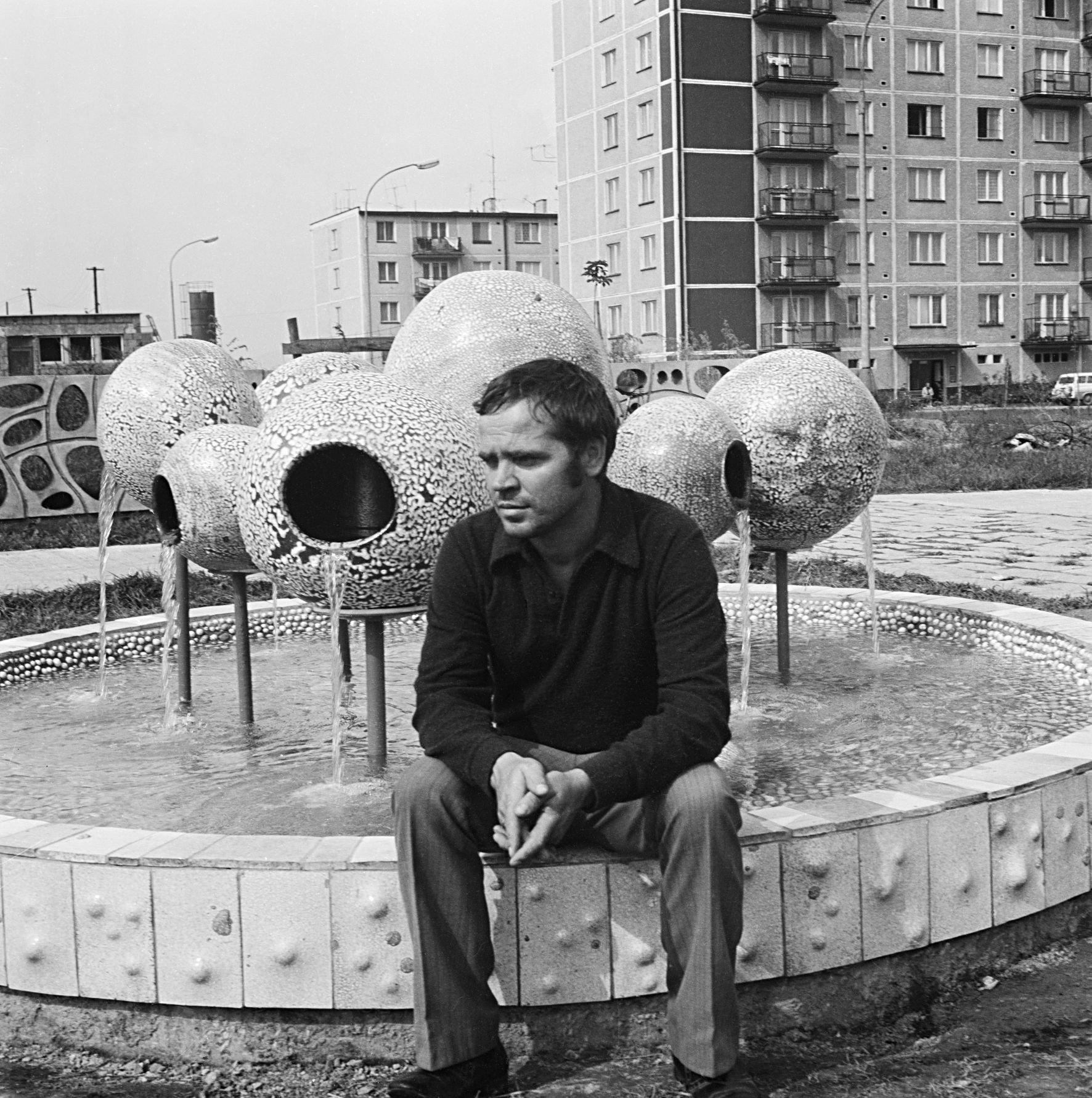
Vital Code: Jozef Sušienka’s Ceramic Sculpture in Public Space

The phenomenon of garden ceramics held a key position in Jozef Sušienka’s work; the design aspect emerged as an essential yet pragmatic branch of his work. A clear part of his extensive work set in public space is becoming (or has already become) a victim of our permanently unclear and often prescient attitude towards modernist art (and architecture). It is invisible or contradicts our visual conformity, tuned to the new and unworn. Activist and institutional attempts in recent years have sought to steer efforts towards knowledge, enlightenment, protection, and, sporadically, towards the revitalization of this still “hot” part of our cultural heritage. What is the condition of Jozef Sušienka’s works in public space today, what challenges do they face, and what messages does his ceramic practice send? The reference points for us in this text will be the key locations of his work: Hlohovec, Piešťany, and Bratislava.
Jozef Sušienka developed his creative vocabulary within the hierarchical structures of state socialism in former Czechoslovakia, where ceramics occupied a position as a regulated yet supported utilitarian discipline. When he began studying in Otto Eckert’s Special Porcelain and Ceramics Studio at the Academy of Applied Arts in Prague in the late 1950s, he was not very enthusiastic about the official tasks of ceramics, which it was supposed to fulfil as primarily an “industrial art”. As he commented alone, “I wanted to do something more unique; I wanted to do sculpture.” The author began to cultivate diverse work tactics in such a formulated setting; even then, guided by his painting and drawing predispositions, he needed to think experimentally. Just as many Czech ceramists (and Imrich Vanek) created in factories for technical/con struction ceramics, in this nomadic practice, he passed through North Bohemian factories in Třemošná and Horní Bříza, later in Moravian Poštorná. Here, he could discover unconventional ceramic approaches; he worked, for example, with raw factory semi-finished products, from which he almost literally “boxed out” a shape using a specific original method while using large sewer pipes or firing moulds for tiles. His works are also clearly recognizable thanks to the persistent research of surface structures implying sculptural, painting and drawing means (from glazes, through scratches, decals to perforations). He was one of the first Slovak ceramists (along with Imrich Vanek and Juraj Marth, colleagues and friends from the Prague studios) who intensively incorporated the heterogeneity, diversity, and experimental drive of the Czech ceramic scene into his creative program. Jozef Sušienka’s work was long perceived through the narrow lens of ceramics as a mate rially defined medium. The general public and the art community registered his sculptures and vessels in public spaces, including parks, gardens, squares, and the interiors of schools, offices, and institutions, somewhat as an obligatory ceramic staffage, benefiting from the possibilities that Head V provided for the application of artistic works in architecture. They knew Ikebana, Prašivka and Kvety, but not the personality of their creator. He was introduced as a sculptor in ceramics in the early 1970s by Ľubor Kára, who recognized his affinity for the elemental language of the archetype and accepted Sušienka’s inclination towards the format of garden or park sculpture with understanding.