

Material of the month April
Totomoxtle
Design as a tool for restoring balance
In Slovakia, we know corn husks primarily from folk art in the form of small dolls and figurines. However, Mexican designer Fernando Laposse uses this common agricultural waste for deeper social reform and a return to ecological balance in the indigenous community of the village of Tonahuixtla. He defines his work as endemic design, where the place of origin of the raw material and its historical context are more important than the resulting form.
The Totomoxtle project was created in 2015 as a response to the decline of local agriculture, the loss of genetic diversity, and mass population emigration. This situation was caused by the flooding of the market with cheap, industrially grown corn, which displaced local varieties. In collaboration with the world’s largest corn gene bank, CIMMYT, Laposse returned native, now nearly extinct plant species to the community.
Local farmers are now being paid not only for the corn but also for its leaves, which were previously considered worthless waste. It is this additional income that allows them to handle the more demanding cultivation of native varieties. A significant part of the overall solution to the problem is also a local workshop functioning as a community center, providing stable work to women and socially disadvantaged groups. This created a functional economic model from which the entire community prospers.
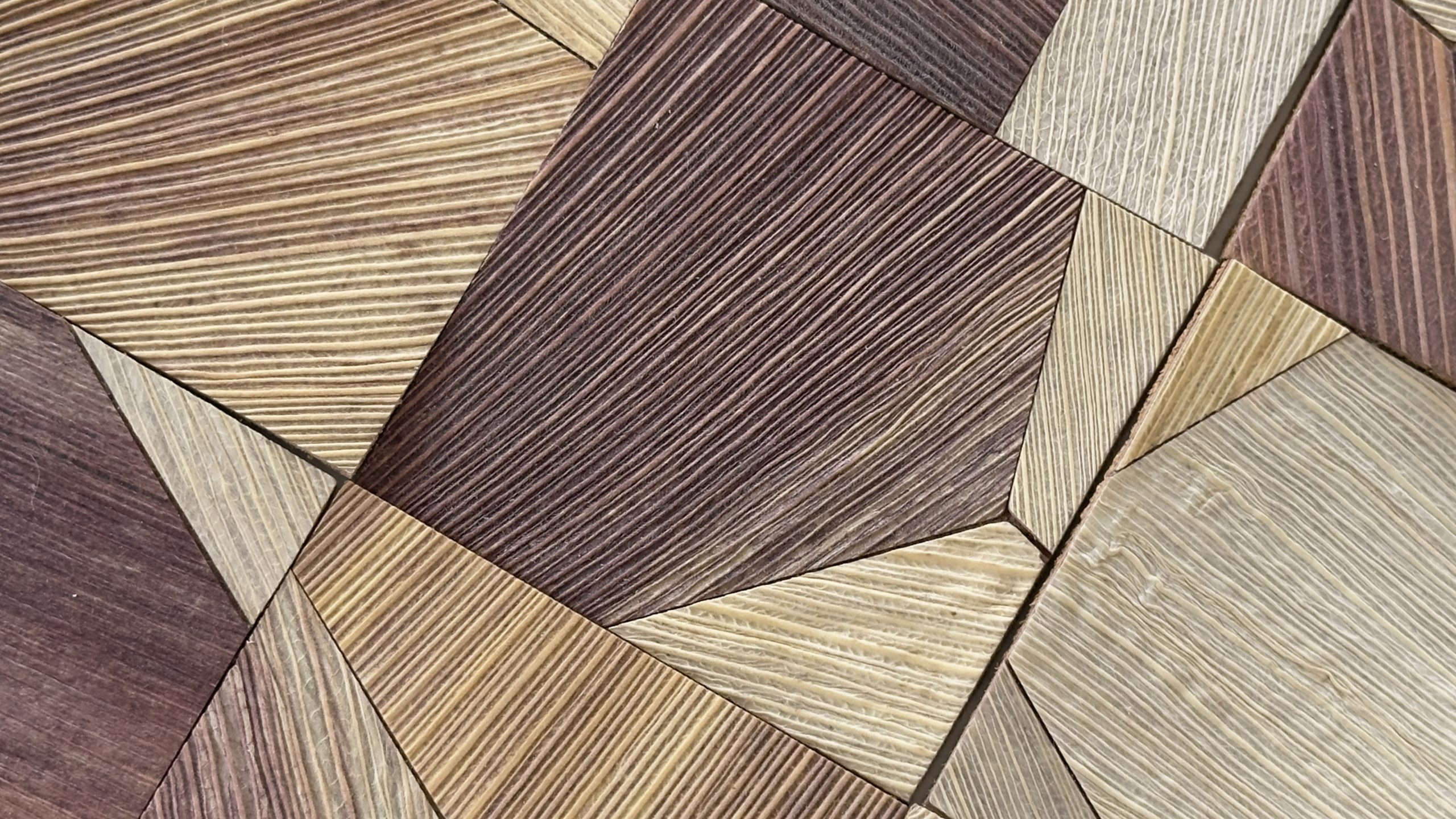
The leaves of ancient corn varieties have become the raw material for a unique inlay suitable for wall coverings, furniture surfaces, lamps, and other interior accessories. Natural biodiversity gives products a wide range of colors from deep purple through warm ochre tones to creamy white, completely without the use of dyes.
The entire concept proves that the future of design does not lie solely in the discovery of new synthetic materials. Even a previously neglected by-product can be transformed into an ethical and fully biodegradable material, thanks to proper marketing. This project did not remain just an artistic prototype, but gradually developed into a commercially successful product.
Slovakia also has a deep tradition of processing straw, flax, sheep’s wool and wood. Laposse’s journey challenges us not to look at these resources solely through the lens of an open-air museum and history, but to see them as raw material for contemporary and commercially viable creation. The project shows that a designer today no longer has to be just a creator of attractive and functional shapes, but can become an active mediator between the community, science, production, and the global market.
Video link: https://youtu.be/0r08iXfJ-CM
Link to the project: https://www.fernandolaposse.com/totomoxle