

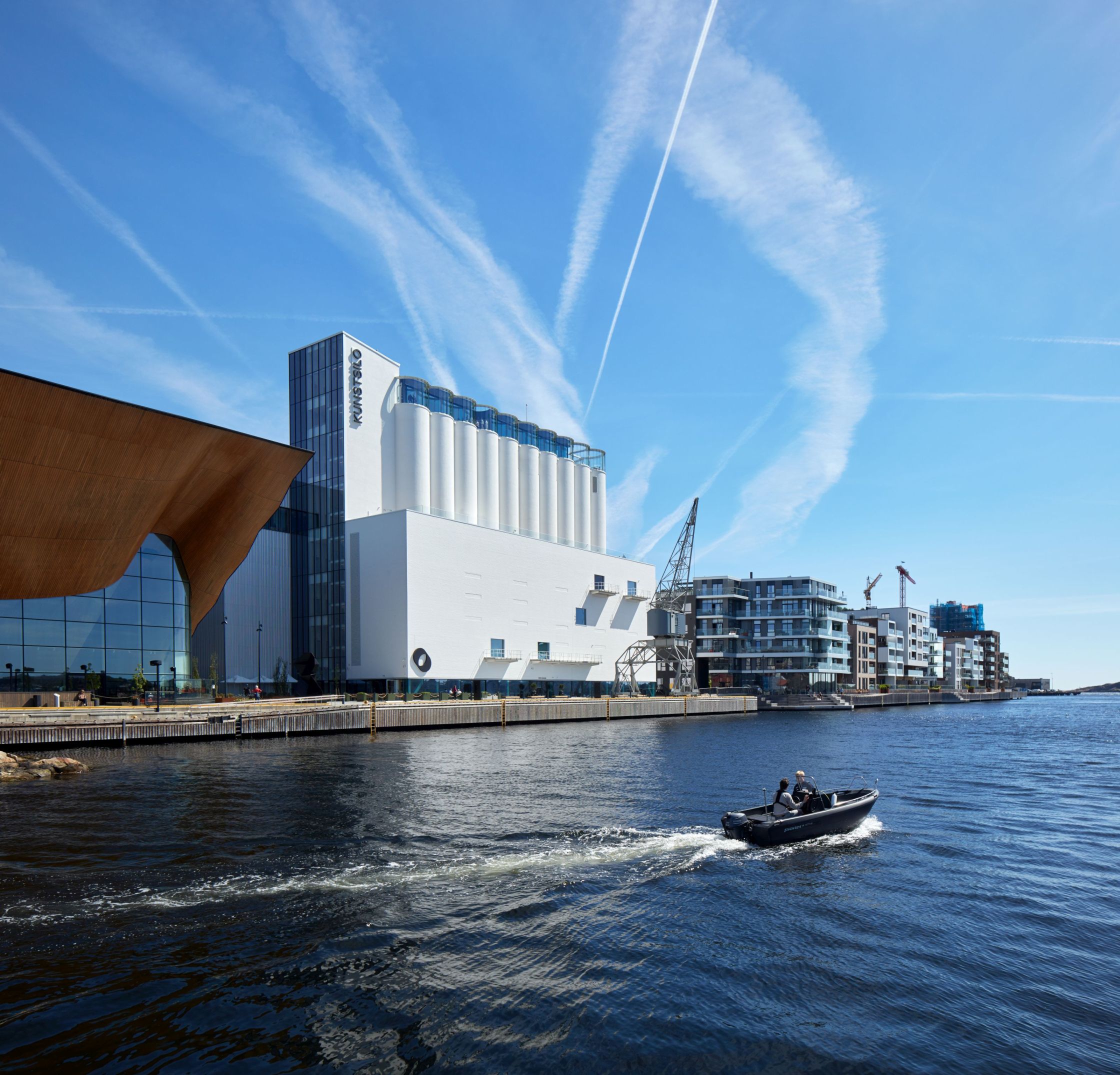
Award for the Most Beautiful Museum in the World: Kunstsilo in Kristiansand

While Slovakia is characterized by a certain staticness, the majesty of the mountains and quiet valleys, the mild climate and the tranquillity of the fertile lowlands, life on the South Norwegian coast – in the Sørlandet region – is characterized by movement. It is a place where the sea wind blows almost constantly from the southeast, from the Skagerrak strait, and shapes not only the rough face of the landscape, but also the nature of the people. The air saturated with salt reminds us that the sea is the one who really decides here. However, for Norwegians, Kristiansand and its adjacent towns represent the Norwegian “sunny riviera”. It is their symbol of summer comfort bathed in a specific, sharp northern light.
However, Kristiansand is not only about a summer idyll. Its historical identity is rooted in the harsh realities of port life: maritime trade, heavy industry, and shipbuilding. Once upon a time, here on the coast, the noise of cargo machines resonated late into the night, and thousands of tons of goods were unloaded. It was this strong port symbolism and the city’s industrial heart that served as the basis for the birth of a new architectural phenomenon. Today, when you walk along the waterfront of the Odderøya peninsula, the unmissable landmark on the horizon is no longer the old silo — a symbol of industry, but a completely new, white object shining like a lighthouse — Kunstsilo.
In a city with fewer than 200,000 inhabitants, an institution was created whose success surprised not only residents but also the international professional public. It is one of the main reasons why I decided to write about it. Of course, it is not the only one. Shortly after its opening in May 2024, Kunstsilo resonated with prestigious global media outlets such as TIME (World’s Greatest Places 2024) and The New York Times (52 Places to Go in 2025). But the surprise came at the end of 2025, when this successful reconstruction of the former grain warehouse won the prestigious Prix Versailles prize at the UNESCO headquarters in Paris and the title WORLD’s MOST BEAUTIFUL MUSEUM.
How could such a relatively “small” project succeed in the huge global competition? What was behind it?
Kunstsilo outmatched such architectural giants as the renovated Grand Palais in Paris, the unique Sound Museum Audeum in Seoul by Keng Kum, the Saka Museum in Bali, or Diriyah Art Futures in Saudi Arabia, as well as the reconstructions and expansions of well-known American museums by the Snøhetta and DLR Group studios.
Even winning this “architectural Oscar” was accompanied by a moment of surprise. As the director of this museum, Maria Mediaas Jørstad, revealed to the student magazine Unikum, the museum did not even apply for the prize on its own initiative: “Usually you apply for such competitions yourself, but in this case we did not. They simply chose us. Last spring, we were informed that we had been shortlisted. The nomination alone was a victory for us. The fact that such a highly qualified jury got to know in detail what Kunstsilo means for the city is incredibly inspiring.”
From functionalism to building reuse: the story of the awakening of an icon
The original grain silo, built in 1935, was never just an ordinary industrial building, although its purpose was strictly utilitarian: to serve as an emergency storage for 15,000 tons of grain. However, architects Arne Korsmo and Sverre Aasland approached the silo design with more than a little honesty. Korsmo, influenced by his travels in Europe and meetings with giants such as Le Corbusier and Eric Mendelsohn, brought pure functionalist “funkis” to Norway. The silo, bearing the inscription AKTIESELSKAPET CHRISTIANSANDS MØLLER (KRISTIANSAND MILLS, PLC), became an icon of modernity in the South of Norway, and its architectural quality was already confirmed in 1939 by a prestigious award from the Houen Fund.
Today’s transformation of the silo, which began with the city council’s decision in 2010 and was spurred by Nicolai Tangena’s donation to the city of Kristiansand in 2015, was not only about preserving and saving one industrial building. Architects, as well as the city council and donors, faced the challenge of how to “enter” the functionalist icon, which is protected as a monument. How to solve the whole thing without destroying the “spirit” of the original silo? The Barcelona architectural team from Mestres Wåge Arquitectes understood that the key to success is not destruction, but “gjenbruk” – the philosophy of reuse, upcycling, which is often a stronger gesture in architecture today than any new construction.