

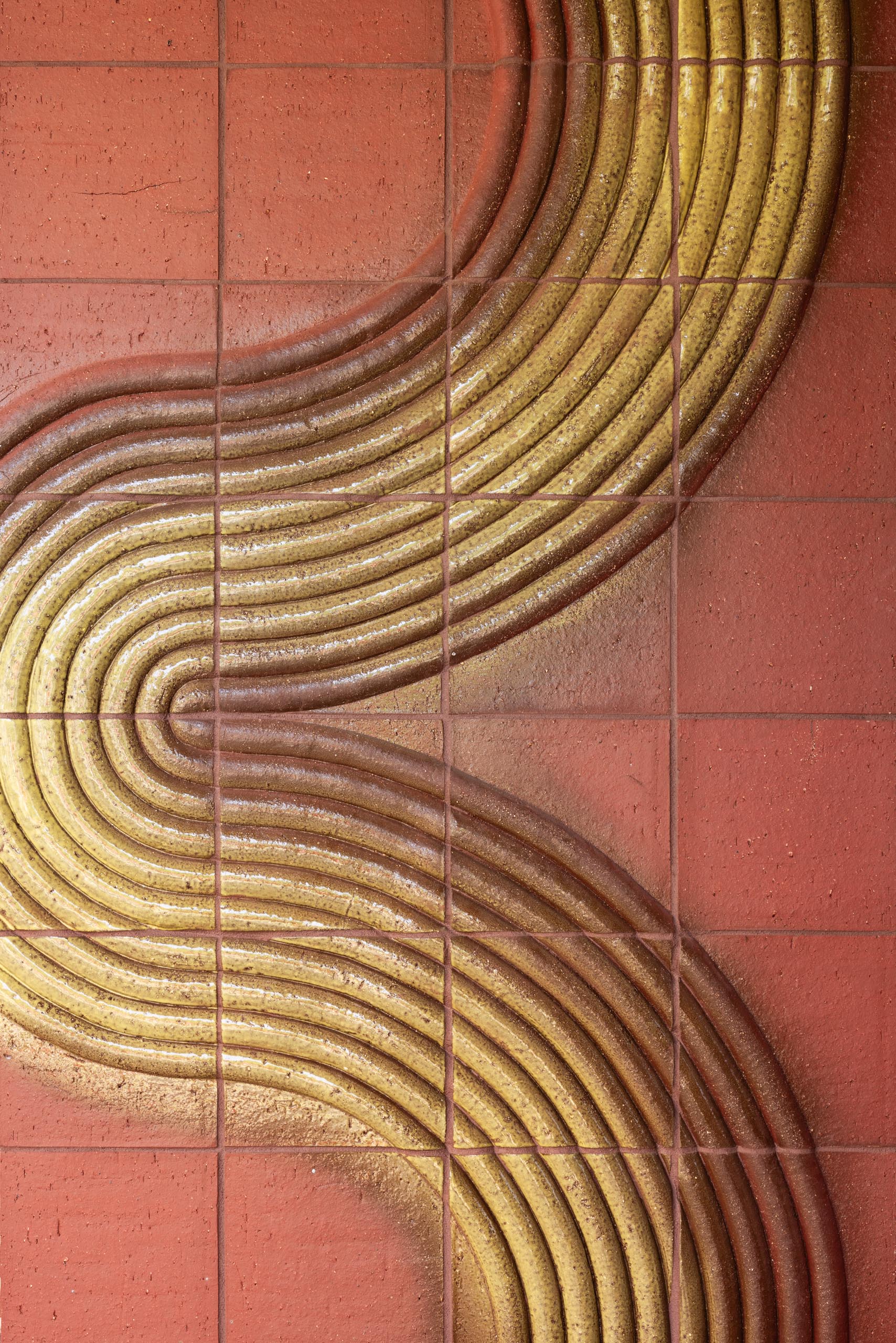
New Perspectives Ceramic Reliefs by Veronika Selingerová for the ZWIRN Complex

Ceramic works for architecture and public spaces — as well as monumental works in general — reached their peak during socialism. It was part of almost every public building, whether schools, houses of mourning, or civic facilities. It was conditioned by the effort to cultivate a socialist society and also by the relevant legislation. The government resolution of 1965, also known as “chapter five”, imposed this obligation on every public building. However, since the 1990s, this type of work has been significantly reduced. The absence of relevant legislation, along with societal changes and current trends in ceramics, may be the reasons for the significant decline in the creation of new works of art for our shared spaces. However, it should be noted that in the last few years, monumental works have returned to the spotlight, especially in the form of mapping projects from the second half of the 20th century. This is well reflected in the number of research projects that have been created that discuss the topic. Among the most recent ones, we could mention Revízia umenia (PGU Žilina, www.reviziaumenia. sk) or the book iel som po meste a na
ulici stálo: Umenie Banskej Bystrice v období socializmu 1948 – 1989. The interest in art in public space (including newly created art) is also reflected in the concept of the new study program Art in Public Space at the Faculty of Architecture and Design of the Slovak University of Technology, but also in last year’s change in construction legislation, which aims to return works of art to architectural projects implemented with state support. One of the few current projects in the field of monumental ceramics is Veronika Selingerová’s reliefs for the ZWIRN multifunctional building complex in Bratislava, which she has been gradually implementing since 2023. An extensive set of works for the entrance areas of individual buildings complements the architecture’s character. We spoke with the author of the ceramic reliefs about their creation, as well as the present and future of ceramic art in architecture.
I mainly associate your work with authorial utility objects made of porcelain, whether under your own direction or under the N.O.B.U.S. studio brand. The current project is one of the few of this type in your portfolio. When did you get the opportunity to collaborate on it?
The implementation of this project with the Compass Architekti studio was preceded by a strong desire, vision, and a wish to create a work of architecture. Honestly, my collaboration with architects began at the Academy of Fine Arts in Bratislava. I longed to collaborate on large ceramic projects. Although specific offers also appeared at that time, I was frightened by them and backed down. During the years when I worked mainly with porcelain and created original utility series, I collected visual material. From it, I created a research project on ceramics in our country and around the world, even at a time when ceramics in architecture could be found only in books and magazines or seen with my own eyes. Today, as I look back, I was seeking courage and personal assurance. Based on the research I had conducted, I planned to approach architectural studios and convince them of the exceptional visual and technical possibilities of ceramic materials. I had only half
of the folder ready; to me, it never seemed complete and representative enough for a presentation.